Written by Claire Schmaltz
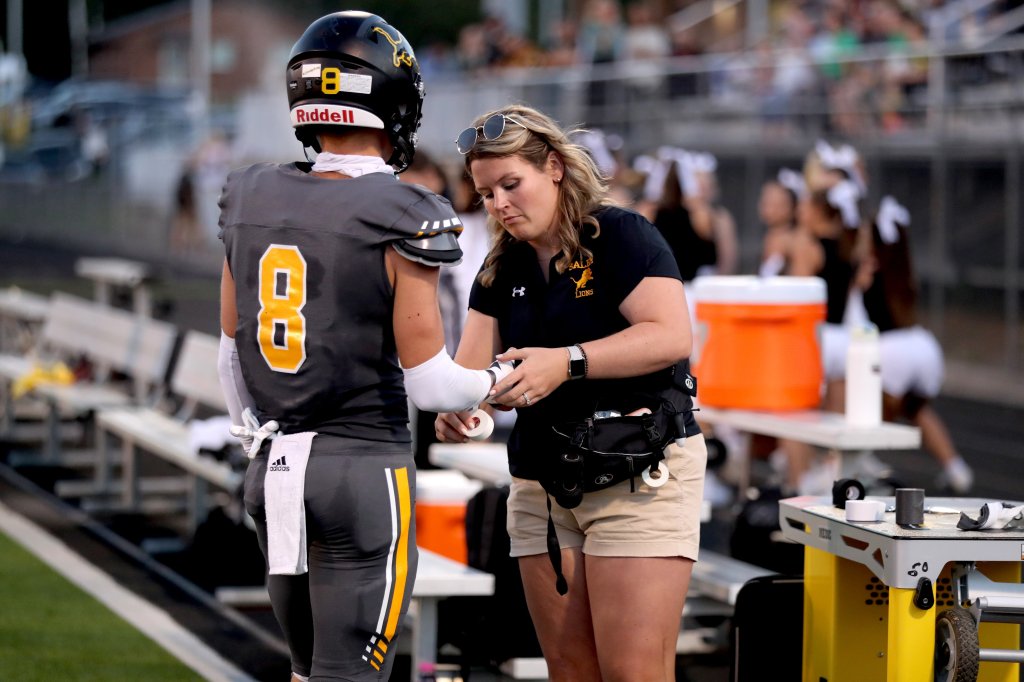
When an athlete is down all eyes look for one person, and within seconds the athletic trainer is by their side assessing the situation and making critical decisions that protect both the athlete’s health and their future in the sport.
Salem Schools Athletic Trainer Mallory Nice has helped lots of athletes recover and get back out on the court or field.
Nice always knew she wanted to work in healthcare and battling through her own injuries in the past made her career decision easier.
¨I was a year round athlete growing up and love sports so I really wanted to be able to combine healthcare and sports together,” she said. “I think through my own experiences of dealing with athletic related injuries, interest in healthcare, and taking an introductory class in high school about athletic training is what inspired me to become an athletic trainer.¨
After she entered the life of an athletic trainer, she soon realized that she had to do much more than just sit around and watch sports.
¨That’s only 10% of my job,¨ she said. “The other 90% is planning and implementing rehabs, new evaluations, referrals, application of modalities, providing emotional and moral support, emergency response, communicating with physicians, scheduling appointments, documentation, communicating with coaches and parents, and the list goes on.¨
Nice has seen a variety of injuries in her career, but said tends to form closer bonds with athletes that have had more serious injuries. ACL injuries take a minimum of six to eight months to recover. Throughout that time Nice is spending 45-60 minutes a day with those athletes for at least five days a week.
When an athlete is out of their sport for that long it is not only physically challenging, it is also very mentally challenging. All of these challenges come straight to Nice. Athletes will think they are fully recovered just to be able to get back out on the court. Nice may not think that is the case.
¨It’s a lot of tough love,” she said, adding that she understands the struggle of wanting to continue to play through injuries because she has been there before herself. Nice has had a total of 10 athletic-related knee surgeries since she was in eighth grade.
¨This is why I 100% empathize with my athletes in wanting to play, but my job is to keep them safe,¨ she said.
Freshman Mykenzie Boyd was out for half her first season of high school volleyball due to a concussion. ¨When Mallory told me I was out I was very sad and thought I would lose all of the volleyball skills I had learned. But Mallory made the journey easier and I know she made the right decision.¨ she said
This job requires late nights and early mornings and the pressure of making quick decisions. But for Nice, the chance to help athletes recover and succeed makes every day worth it.
¨The most rewarding part of my job is simply getting to watch my athletes perform after a significant injury,” said Nice. “Athletic training is one of the only healthcare professions you are able to see a patient from start to finish.¨
Balancing the regular athletic training responsibilities is hard enough, but for Nice it does not end there. She is also a science teacher and inside the classroom Nice helps students develop important skills that they will use for the rest of their lives.
¨I wish I could say it was always easy, but that is not the case,” she said. “There are some days between both jobs that I am working 15-18 hour days with no breaks.¨
But with all of this hard work also comes satisfying rewards like watching athletes be able to do what they love again and seeing students grow academically.
Whether in the classroom or on the sidelines, Nice continues to make an impact on students everyday. Through long hours and dedication she makes sure that students are healthy, confident and ready to do what they love.
 Salem High School Media
Leave a comment