By: Flora Wade
In order to eliminate distractions, the Indiana legislature has passed a bill that bans devices in schools. On March 11 Governor Eric Holcomb signed a law forbidding personal devices to be used during school hours.
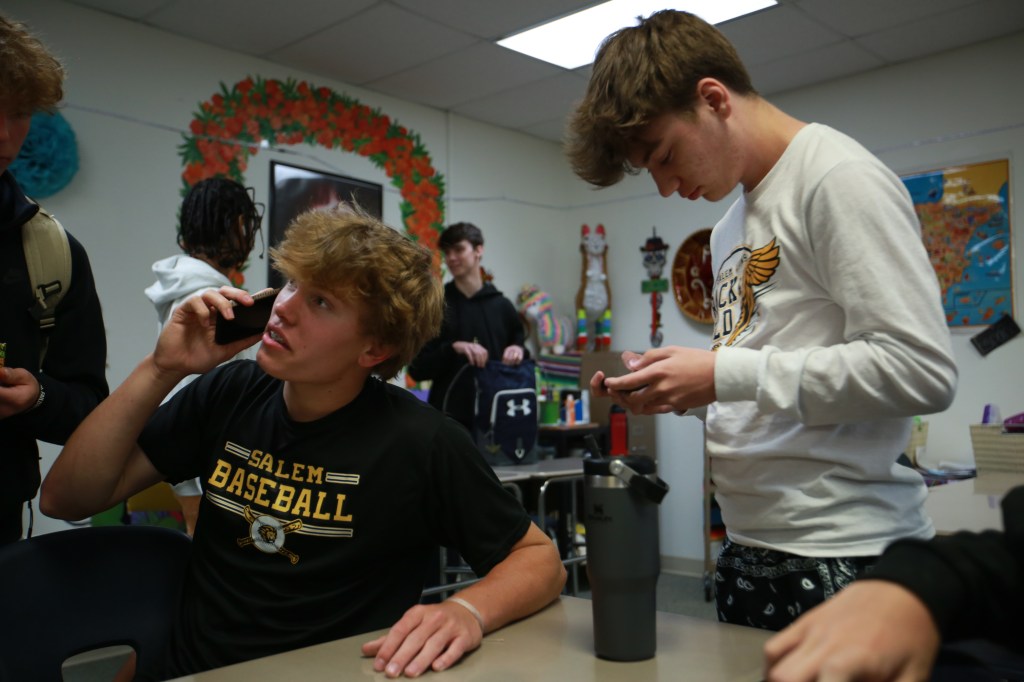
School systems in Indiana are making their changes to enforce this law starting July 1. Although schools may have had their original phone policies, they will change and conform to the Indiana law. Holcomb believes that this will help the students engage and become more involved in their classes. The ban aims to prevent online bullying and targeting during school as well.
Many people find this law controversial. Parents and students are concerned over the minimized communication and lack of resources that phones provide.
The law is not violated when devices are used for apps doctors require. For example, diabetics can have their insulin levels monitored through their phones. On the other hand, people are using their devices for art, projects and agendas. Ipads and Kindles were created to be more personalized and convenient compared to the laptops some schools provide. They can allow for a more efficient and creative learning environment, if used correctly.
SHS sophomore Raewyn Perry said, “I use my devices throughout the day a lot. I not only use my phone for research, but I also use my iPad for projects. If my project needs creative elements, I am able to make things on my art app. I can also work on projects on my tablet.”
Many believe tablets and devices allow for a more productive learning experience.
“Another great feature of my tablet is that I have all of my stuff written out on it for my current assignments. It’s sort of like a digital planner,” Perry said.
The proposed template for the student handbook states: “This rule is not violated when the student has been given permission from a teacher to use a wireless device for educational purposes during instructional time”.
Salem Community Schools has a first, second and third offense punishment system. In order to keep the students conformed to this new law, teachers are taking more specific measures to make sure the law is enforced. It is up to teacher discretion on when students can use their devices.
This law gives more support to the teachers’ decisions, when eliminating phone usage in classrooms.
Salem Schools superintendent Jill Mires said, “It is a major concern that we are already on them (devices) so much during down time, that the instructional time needs to be held sacred and the teachers need a little help with that.”
If teachers allow devices during class many students are found using social media or entertainment instead of using them for school work.
“The problem is not overstepping the boundaries,” said Mires. If your teacher says ‘Yes, you can do this,’ then do that. Sometimes we get an inch and we take miles.”
Monika Spaulding, the newspaper and media teacher at SHS, uses devices each day in her classes.
“If they need the phone for an assignment, they can have it out,” Spaulding said. “In my media class, many students use their phones for photos, accessing their Google drive for photos, videos, etc. I’m in the process of adding more devices to my classroom for recording and photos so students can use those instead of their personal devices for classroom use.”
Although Spaulding uses devices regularly in her classroom, she agrees that they can both benefit and distract learning environments. Teachers believe that the distractions will be eliminated if the law is properly executed and only used for proper assignments.
“This law will not be effective unless it is enforced,” said Spaulding. “I think it’s a great law because cellphones are definitely a distraction to students. They hear it buzz or feel it vibrate, and they want to pick it up and see who is messaging them. As soon as they hear the notification, you’ve lost them as a teacher. They are no longer focused on the work in front of them.”
Administrators in Indiana schools are responsible for handling devices, as they are sent to the office often.
“With the current policy, I only see a couple of cell phone violations per week,” said SHS Assistant Principal Jerry Hickey. Once the law changes, I would anticipate that it would be much more often.”
The principals get a view in every classroom to see how devices affect education. “As a society, we have become obsessed with social media and constantly having to be entertained by our phones. Even when students are using their phones for ‘educational purposes,’ they are constantly getting notifications and distractions,” Hickey said.
Many say it is important to find balance, and not overstep the boundaries teachers set for their students. Technology can be such a benefit and a drawback in everyday lives.
Salem Middle School Assistant Principal Brett Miller said, “There are positives and negatives. Most all the information and answers needed can be accessed in seconds. We also rely very heavily on technology and devices that we don’t always have the common sense and problem solving skills needed. We just want the answer right away. Having a balance of both is important.”
Indiana schools will work toward finding a balance with technology, and observe how the new law spans out through the upcoming school year.
 Salem High School Media
Leave a comment